In scikit-learn (sklearn), the StandardScaler is a preprocessing technique used to standardize features by removing the mean and scaling them to have a unit variance. Standardization is a common step in many machine learning algorithms, especially those that involve distance-based calculations or optimization processes, as it helps ensure that all features contribute equally to the analysis.
fit_transform computes the mean and standard deviation of each feature in data and then scales and centers the data based on these statistics.
Here’s a brief overview of how to use the StandardScaler in scikit-learn:
# standardizing the data
from sklearn.preprocessing import StandardScaler
scaler = StandardScaler()
data_scaled = scaler.fit_transform(data)

# statistics of scaled data
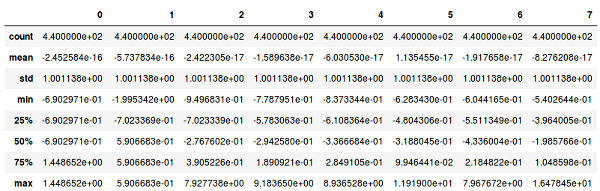
pd.DataFrame(data_scaled).describe()
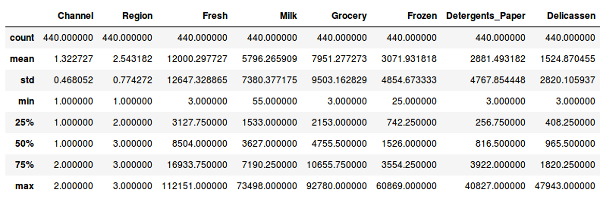
Before standardization:
After standardization:
GO ONE LEVEL DEEPER
Standardization changes scale, not information
StandardScaler centers each feature using its training mean and scales it by its training standard deviation. The resulting values express distance from the mean in standard-deviation units.
Use the transformer safely
FIT
Training data
Estimate each feature’s mean and standard deviation here only.
→
Transform
Apply those same learned values to validation, test, and production data.
PIPE
Pipeline
Bundle scaling with the model to prevent leakage and deployment drift.
Keep in mind
Scaling is important for distance- and gradient-based models.
Tree models usually do not require standardization.
StandardScaler is sensitive to extreme outliers; consider robust scaling when appropriate.